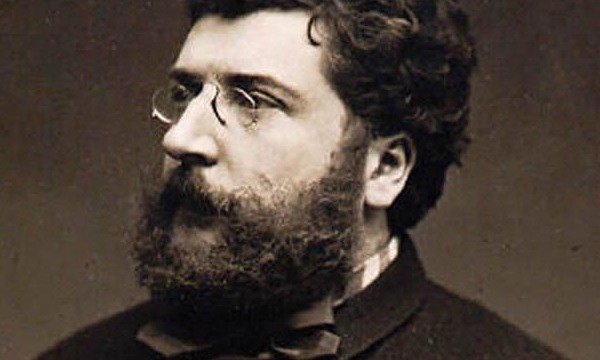
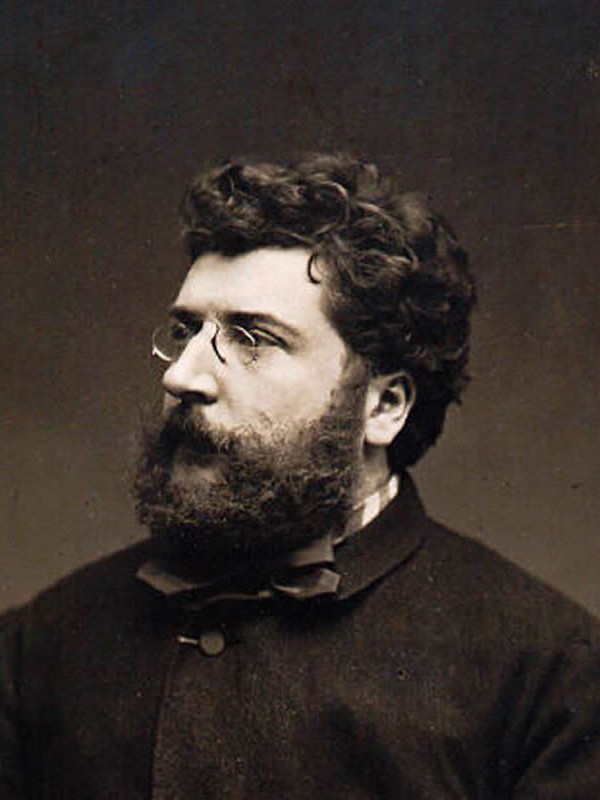
Georges Bizet
In 1857, he won part of a prize donated by Jacques Offenbach with his composition of the one-act operetta Le docteur Miracle. He also won the Prix de Rome, which entitled him to a three-year scholarship in Rome. There, his talent blossomed in works such as the opera buffa Don Procopio (1858–59). He also wrote his only significant liturgical work, the Te Deum (1858), which remained unpublished until 1971. In 1863, he composed the opera Les pêcheurs de perles (The Pearl Fishers) for the Théâtre Lyrique, which was not initially successful. This was followed by the opera La jolie fille de Perth (premiered at the Théâtre Lyrique in 1867), a symphony called Roma (1868), and Jeux d’enfants (Games for Children) for piano four hands (1871).
The popular L’Arlésienne was originally a composition written for a play by Alphonse Daudet, which premiered in 1872. In the same year, the one-act opéra comique Djamileh premiered, which is often seen as a precursor to Carmen. Bizet's best-known work, the opera Carmen (1875), is based on the novella of the same name by Prosper Mérimée from 1846. Bizet composed the main role for mezzo-soprano. Carmen, initially rejected by the audience, received praise from famous contemporaries such as Debussy, Nietzsche, Saint-Saëns, and Tchaikovsky. Brahms attended over twenty performances and considered it the best opera to have been performed in Europe since the Franco-Prussian War. The composers' views proved prophetic in that Carmen has since become one of the most popular works in the entire opera repertoire.
Upcoming Performances



The schedule for the following season will be released soon. Stay tuned!
Stay informed on the latest news and events! Subscribe to our Newsletter.
Das könnte Sie auch interessieren
.jpg)
%20(1).jpg)
%20(1).jpg)
%20(1).jpg)

.jpg)


.jpg)
%20(1).jpg)
.jpg)
%20(1).jpg)

.jpg)
.jpg)
%20(1).jpg)
%20(1).jpg)
.jpg)
.jpg)
